
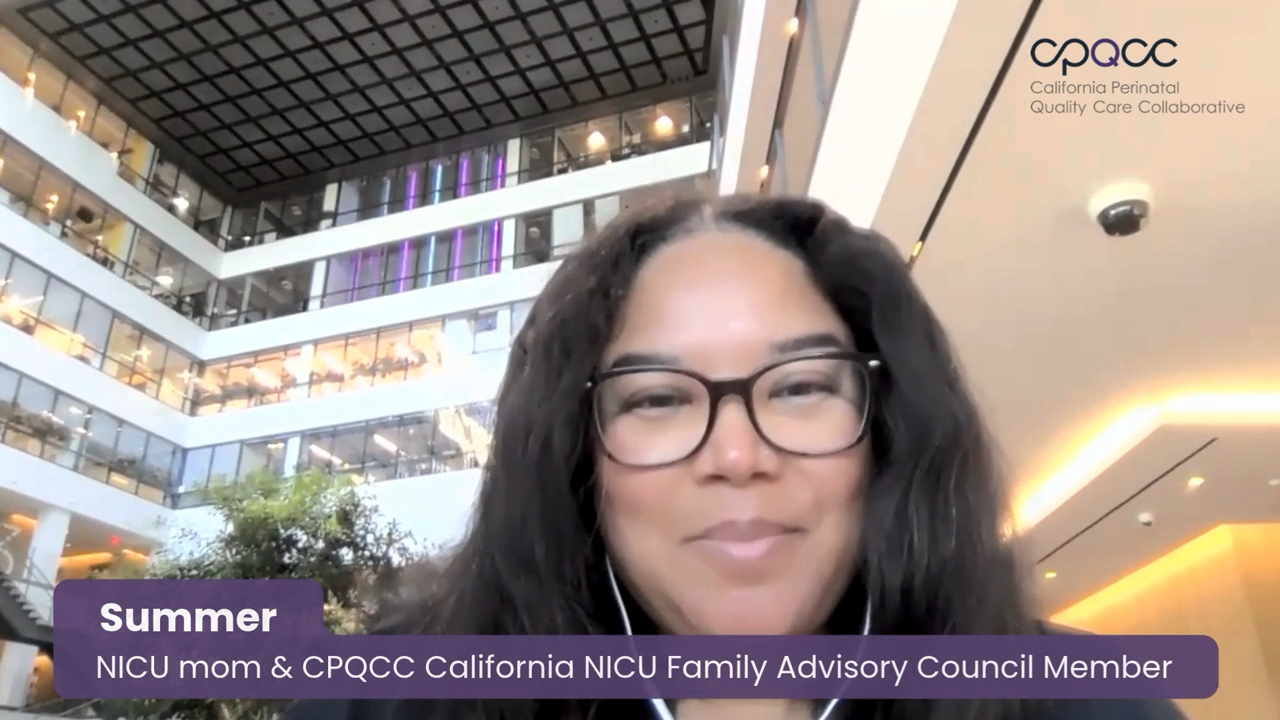
Listen to Summer, member of CPQCC's California NICU Family Advisory Council, share her experience with communication, highlighting what helped, what didn’t, and how connection shaped her NICU journey.
Communication and Connection in the NICU: What Families Need While Navigating their NICU Experience
I'm a mother of five sons. I'm also a longtime advocate for families navigating maternal and infant health, and that advocacy was most profoundly shaped by my own NICU experience. About 20 years ago, my second pregnancy was uneventful until the day my water broke. When I went to the hospital, I was told my water hadn't ruptured and that I had probably just urinated on myself. I knew that wasn't true, but I trusted the system.
My OB was never notified after that, and my concerns were mostly ignored. About a week later, I returned in active labor. Within hours, my baby's heart rate began to drop with every contraction. Everything started to feel so fast and like I couldn't keep up with the pace we were moving. I was placed under a general anesthesia and taken in for an emergency C-section that I had not planned for. Because who plans for an emergency C-section?
When I woke up, I remember feeling so alone. Hours had passed before anyone told me where my son was or how he was doing. Eventually, my husband walked in with a neonatologist who told us our son needed to be transported immediately to another hospital. I wasn't allowed to hold him. I couldn't see him until I asked because they were already preparing him for transportation.
They allowed me to go to the NICU and I saw my son for the first time in a mobile incubator. He was wearing nothing but a diaper, his body was covered in wires, and his chest was moving so rapidly because he was struggling to breathe. It was at that moment that I started to somewhat realize that my life was going to be changed forever. This was not a normal birth experience. This was my second child, so I had had a normal birth experience. This was brand new.
What helped during the NICU journey was having clear, compassionate communication from providers. Providers who were willing to slow down and explain what was happening to me, and providers who treated us like partners rather than spectators of our child's development. When someone used language that acknowledged our fear, made us feel seen, acknowledged our humanity, and especially acknowledged our role as parents, as partners in this process, that really helped ground us.
What didn't help was the silence. When we were left without updates, when we were repeatedly told what they expected to happen, but it didn't happen. Like, “Maybe he'll be discharged today,” or “Maybe he'll be brought back to this hospital before he's discharged.” But then that didn't happen right away.
Being left without the updates, hearing only the risks and deficits without context or any hope that they wouldn't affect his development, having our concerns minimized instead of explored, and just not being listened to when we shared our concerns didn’t help.
Our son spent about a month in the NICU, and while he eventually came home, the NICU was still a part of our life. We left the NICU, but the NICU didn't leave us. For years, there were medical visits, and those medical visits triggered panic. He had night terrors and meltdowns every time we were in any kind of medical facility. And at the time, I didn't have language for it. But I know now, 20 years later, that was trauma that he was experiencing. And it was a long road for us. But today, our son is 20, and he's a thriving college student. He's focusing on music production and composing original pieces.
The outcome that we had still doesn't erase how critical those early interactions were for bonding. Our mental health was affected. And honestly, our long-term trust in medical care systems was affected. That experience is why I now facilitate trauma-informed NICU parent support groups and work alongside families, especially Black families, to create spaces where they feel seen and heard. And they know that they're going to be listened to.
My hope for providers is honestly not that complicated. For the providers, I would ask that you remember that when you speak, every single word you say, every pause, every assumption you make, every explanation you give or explanation you fail to give, has an impact on that family. And communication is not just information. Communication is absolutely a form of care, and it is one of the best forms of care that you can provide. And the connection that you make isn't extra – it really is a part of the healing process.
In moments of extreme vulnerability when NICU families feel very vulnerable, communication and connection often become the most defining elements of a family's NICU experience. And I would hope that you would remember that.